Same Day Septic Services | Call today 813-754-9891
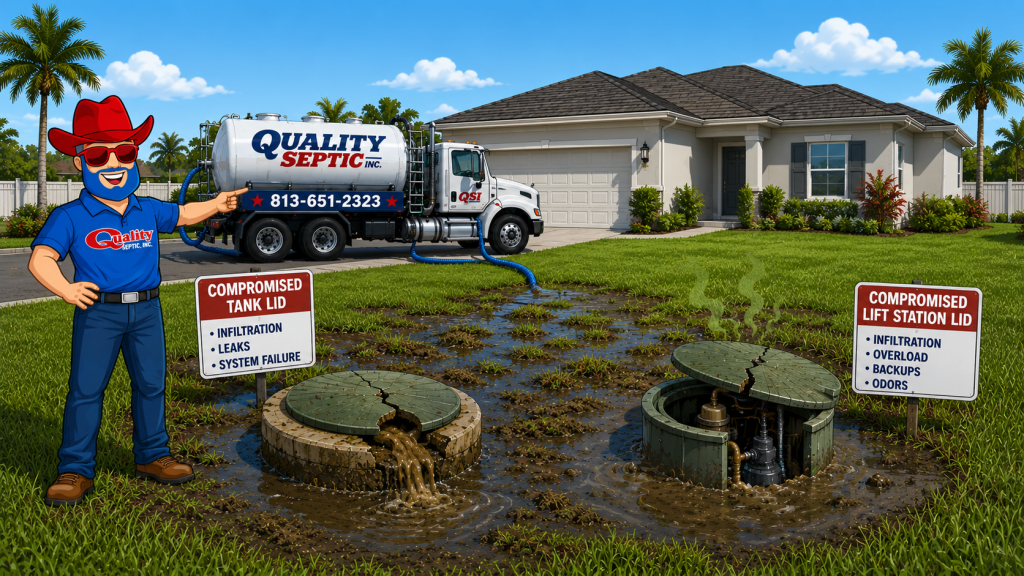
The Most Overlooked Vulnerability: Compromised Septic & Lift Station Lid
When homeowners think about septic system failure, they usually worry about what’s going down their drains—like grease, flushable wipes, or harsh chemicals. But one of the most common causes of system failure actually comes from the outside, and it starts right at the surface: your lids.
Whether it’s your main septic tank cover or your lift station lid, these components are your system’s primary line of defense. When a lid is cracked, unsealed, or improperly installed, it breaks the airtight, watertight seal your system needs to function.
Here is why a compromised lid is a ticking time bomb for your septic system, and how to protect your property from a costly failure.
1. What Happens When a Lid Breaks or Fails?
Your septic tank and lift station are engineered to be completely sealed, closed-loop environments. They are designed to process wastewater from your home—and nothing else. When a lid is compromised, it allows external elements into the system that rapidly trigger a breakdown.
Dirt and Yard Debris Intrusion
A cracked or loose lid acts like an open funnel for whatever is sitting on your lawn. Lawn clippings, mulch, sand, and soil constantly fall or wash through the gaps.
-
In the Septic Tank: This debris settles at the bottom, rapidly building up the sludge layer. This cuts down the available space for wastewater treatment, leading to premature backups and requiring much more frequent pump-outs.
-
In the Lift Station: Sand and grit are highly abrasive. When they fall into a lift station’s wet well, they wear down the pump’s impellers, cutting the lifespan of your expensive pump in half.
Surface Water Inflow
Even without heavy storms, everyday yard water—from morning dew, lawn sprinklers, or standard roof runoff—will find its way into a compromised lid. This constant, unintended stream of water causes hydraulic overload, forcing wastewater out of the tank before the solids have time to properly separate.
2. The Hidden Danger: Lift Station Pump Failures
While a broken septic lid is bad, a compromised lift station lid can cause an immediate, messy emergency. Lift stations rely on mechanical parts that are incredibly sensitive to outside interference.
-
Float Switch Interference: Lift stations use floating switches to tell the pump when to turn on and off. When yard debris, twigs, or dirt fall through a broken lid, they can physically trap or pin these floats. If a float gets stuck down, the pump won’t turn on, causing an immediate sewage backup into your home.
-
Mechanical Jams: Larger debris like rocks, roots, or thick mulch falling through a broken cover can jam the pump’s intake entirely, burning out the motor.
3. Safety Hazards: More Than Just System Damage
A compromised lid isn’t just a mechanical hazard; it’s a massive safety liability on your property.
-
Structural Collapse: Old concrete lids naturally degrade over time due to the corrosive sewer gases ($H_2S$ or hydrogen sulfide) trapped inside the tank. A lid that looks fine on top might be completely corrozed and paper-thin underneath, creating a severe risk of collapsing if stepped on or run over by a lawnmower.
-
Open Access Hazards: Loose or lightweight lids that aren’t properly bolted down or locked pose a serious risk to curious children and pets.
4. Warning Signs of a Compromised system
You don’t always have to dig up your yard to know your covers are in bad shape. Keep an eye out for these common warning signs:
-
Depressions or Small Sinkholes: If you notice the grass or soil sinking in a circle around your septic access area, it means dirt is actively falling through a gap in the top of your tank or riser.
-
Persistent Sewage Odors: A properly sealed septic or lift station system should never smell on the surface. If you catch a whiff of sewer gas while walking across the yard, your lid seal or gasket has failed.
-
Soggy Grass Over the Tank: If the grass directly on top of your tank is unusually bright green or soggy compared to the rest of the yard, effluent may be escaping, or water may be constantly cycling in and out of a broken cover.
How to Correctly Secure and Upgrade Your system
Fixing a lid issue is one of the most cost-effective ways to prevent a multi-thousand-dollar system replacement.
-
Install Heavy-Duty Risers: If your tank is buried underground, consider installing riser extensions. Risers bring the access point right up to ground level, making inspections easy and preventing dirt from ever sitting on top of the system
-
Switch to Modern Materials: Old concrete materials crumble. Upgrading to heavy-duty, UV-resistant poly/plastic lids ensures a lifetime of strength without the risk of chemical corrosion from tank gases.
-
Ensure Proper Seals and Bolts: Lift station covers and riser covers should always feature a clean rubber gasket and be secured tightly with stainless steel bolts to keep the system watertight and child-proof.