Septic System Inspections | Call Today 813-754-9891
Failed Septic Inspection, What’s next ?
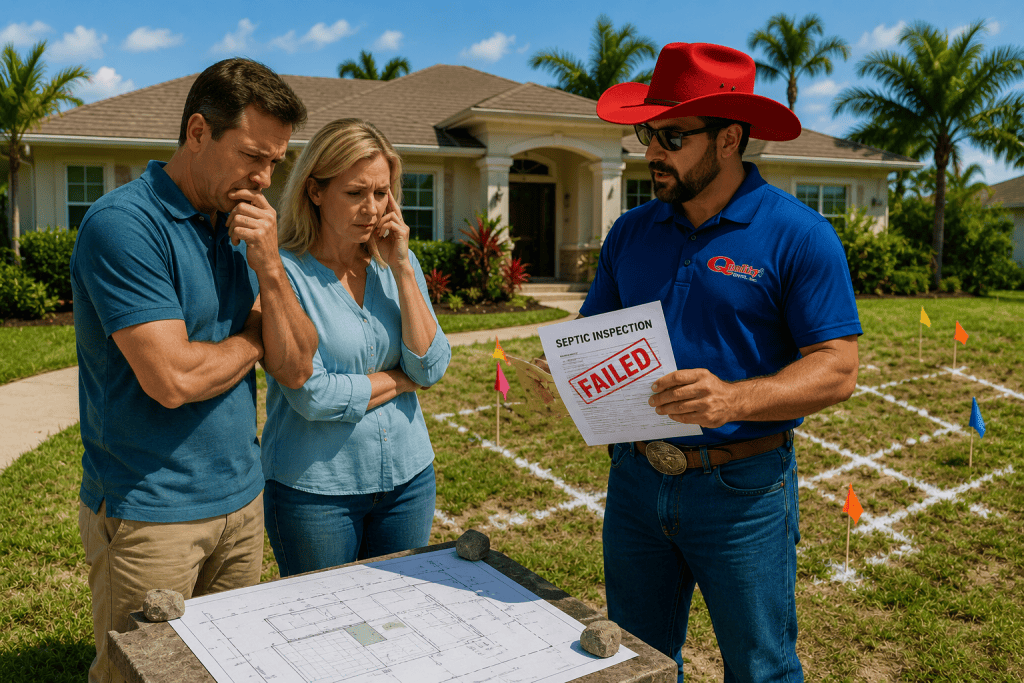
Hearing that your septic system has failed an inspection can instantly cause your stomach to drop. Whether you discovered the failure during a routine checkup, a commercial code review, or right in the middle of selling your home, your mind probably jumps straight to worst-case scenarios: massive bills, destroyed landscaping, and endless regulatory delays.
First, take a deep breath. A failed inspection report is not an immediate death sentence for your property, nor does it automatically mean you have to buy a completely new system.
At Quality Septic, we have spent over 30 years helping local property owners turn failed inspection reports into affordable, clear action plans. Here is exactly what happens next and the steps you need to take to resolve the issue smoothly.
Step 1: Pinpoint the Exact issue that failed
“Failed” is a broad term. Before you authorize any work, you need to look at the diagnostic report to understand exactly which component stopped working. Septic failures generally fall into two distinct categories:
Small-Scale / Component Failures
These are highly localized issues that can usually be repaired quickly without touching your drainfield soil:
Broken Baffles or Sanitary Tees: Raw solids are escaping into the secondary lines because an internal pipe cracked.
Burned-Out Lift Pump: The mechanical pump failed, causing the liquid to back up into the dosing tank.
Cracked Lids or Risers: Surface stormwater is leaking into the tank from above, artificially flooding your system.
Large-Scale / Structural Failures
These involve the absorption capacity of your lot and require more comprehensive structural solutions:
Biomat Clogging: A thick, slimy layer of bacteria has completely sealed the soil beneath your drainfield trenches, preventing effluent from filtering down.
Water Table Saturation: Heavy seasonal rainfall has pushed the groundwater table too high, flooding the drainfield from below.
Collapsed Infrastructure: Heavy vehicles or root systems have physically crushed underground pipes or cracked the main concrete tank structure.
Step 2: Establish an Immediate Damage Control Routine
While you work with a professional to map out a structural fix, you must immediately adjust how your household or business uses water to prevent a raw sewage backup inside the building.
1.Cut Water Usage by 50%
Spread out laundry loads across the week, take short showers, and ensure absolutely no water runs continuously. The less volume entering the tank, the less pressure on the failure point.
2.Check for Running Toilets
A single toilet with a leaking flapper valve can dump hundreds of gallons of silent water down your drains daily, completely drowning a struggling drainfield.
3.Reroute Storm Gutters
Ensure all roof gutters and driveway drainage channels point completely away from your septic tank and drainfield area.
Step 3: Explore Your Legal Repair Options
In Florida, major septic modifications require formal approval. Depending on your diagnostic report, a licensed contractor will guide you through your options:
Targeted Component Replacement: Swapping out a failed pump, float switch, or broken pipe line to restore immediate functionality.
Drainfield Rejuvenation or Expansion: If only a portion of your absorption trenches are clogged, adding a secondary line or introducing specialized treatments can save the system.
Engineered System Upgrades: If your high water table caused the failure, we can design a legally compliant mounded system or an advanced Aerobic Treatment Unit (ATU) to clear state environmental health codes.
Turn a Failed Report into a Seamless Solution Since 1994
If another company handed you a failed inspection report and quoted you an astronomical price for a total replacement, it is always smart to get an honest second opinion. Since 1994, Quality Septic has been the premier name for transparent diagnostics and reliable system restorations across Central Florida.
Based proudly in Plant City, our family-owned business brings over 30 years of direct excavation, permitting, and engineering experience to your job site. We know exactly how to satisfy local county health inspectors while keeping your project costs as low as possible. We proudly provide honest second opinions and fast structural restorations across our 12 primary communities:
Plant City & Lakeland
Tampa & Temple Terrace
Lutz & Land O’ Lakes
Riverview & Valrico
Seffner & Thonotosassa
Lithia & Mulberry
We don’t invent problems, and we don’t push unnecessary full replacements if a smart, targeted structural repair can safely fix the issue. Contact Quality Septic today to have our team review your failed inspection report and build a fast, stress-free action plan for your property.